

Company / Network forensics
A missing sliver of network traffic can explain a bad trade, a dropped call or a stolen file. NIKSUN has built its business around saving the evidence before anyone knows which evidence matters.
The hedge fund had a problem that looked, at first, like a problem with trading. Decisions were going wrong. Somewhere in the machinery that carries market prices to the systems that act on them, information was disappearing. A sophisticated operation could make an unsophisticated mistake: respond to an incomplete picture of the market.
- NIKSUN records network traffic so teams can investigate an incident after it happens.
- Its security and performance tools can examine the same underlying evidence.
- The tradeoff is concrete: more retained traffic demands more storage, access controls and careful capture design.
NIKSUN’s account of the unnamed customer describes what NetVCR and NetTradeWatch uncovered: bursts of bandwidth use, sequence gaps, and missing market data. The useful discovery was beneath the trading decision, in the plumbing that supplied it. Sub-second analysis made the gaps visible. The published account identifies the mechanism; it does not put a dollar value on the recovered trading performance.
It is a good introduction to a company whose product name, NetVCR, sounds as though someone has left a video cassette in the server room. The name has aged better than the cassette. Record now. Examine later. The difficult part is knowing how much of the past to keep.
A recorder before a verdict
Parag Pruthi founded NIKSUN in 1997, following doctoral work on modeling packet traffic with chaotic maps. In a 2019 interview, he described a problem with trying to reduce the internet to a tidy set of measurements. New applications could appear before their vulnerabilities were understood. The information needed to explain an outcome depended on the particular problem being investigated.
That observation gives the company its intellectual shape. Decide too early which data matters, and you may discard the thing that answers the next question. A traffic summary can tell you that a connection existed. A retained packet can provide much more of the actual exchange. Which detail becomes decisive may only be apparent after the incident.
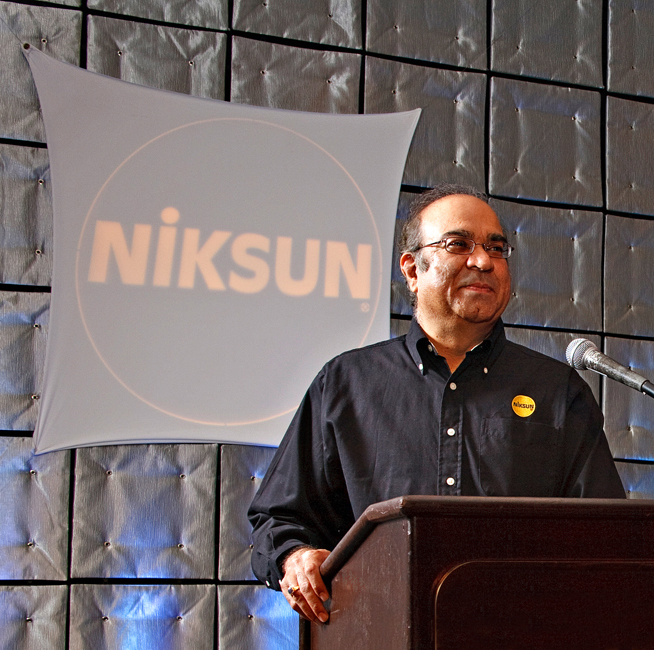
In his 2018 discussion with security specialist Ed Amoroso, Pruthi offered a brisk explanation of the engineering demand. Customers wanted capture without packet loss, even as traffic rates increased. They also needed the resulting record indexed so an analyst could find something in it. A warehouse is of limited use if every investigation begins by emptying its shelves.
“the packets they miss are inevitably the ones their analysts need.”Parag Pruthi, speaking with Ed Amoroso, 2018
NIKSUN’s answer combines recording with search and reconstruction. Its Knowledge Warehouse brings retained traffic and other operational data into an indexed record. An analyst can start from a suspicious connection or a performance symptom and work back through the activity around it. The company’s motto, Know the Unknown, becomes less mysterious when translated into that sequence.
One traffic record, several jobs
A security analyst and a network engineer can arrive at the same incident from different directions. One wants to know whether a large transfer is theft. The other wants to know why an application is slow. Looking at a common traffic history can help both establish what happened before debating what it means.
The product range divides those jobs. NetDetectorLive handles network detection and forensic investigation while NetVCR concentrates on network and application performance, with session diagrams that help localize delay. LogWave adds log and event correlation, while NetOmni brings distributed NIKSUN units into a central view. NetTradeWatch specializes in trading traffic, where an out-of-sequence message deserves more attention than its size might suggest.
PACKETSFLOWSLOGSMETRICS
INDEX + CORRELATENIKSUN Knowledge Warehouse
SecurityWhat moved? Who sent it?
PerformanceWhere did the delay begin?
The customer problems help to clarify these distinctions. NIKSUN’s healthcare case illustrates how operational disruption led investigators to malicious user agents and malware disguised as a PDF. A telephony case revealed that dropped calls at an auto services franchise could be traced back to improper network load balancing. Troublesome industrial traffic for a manufacturer ended up being a configuration issue in its programmable logic controller.
These are vendor-published case studies, usually without naming clients, and they illustrate the range of investigations NIKSUN’s tools are designed to support. They also remind us that a strange network event does not automatically indicate an attack; sometimes, a configuration setting with excellent credentials turns out to have poor judgment.
NIKSUN boasts a diverse clientele that includes enterprises, governments, and service providers. With over 1,000 customers across 30 countries, its emphasis on sensitive infrastructure is reflected in features such as offline deployments and role-based access. In May 2025, the company announced its fifth consecutive Common Criteria certification covering its NetOmni and NetDetector/NetVCR/LogWave suite. While the certification applies to evaluated products and requirements, the success of any deployment still relies on careful design.
Memory has a price
Keeping a record sounds simple until the arithmetic comes into play. A sustained stream of 100 gigabits per second adds up to 12.5 gigabytes each second, which translates to approximately 1.08 petabytes of raw traffic stored over 24 hours before accounting for compression or storage overhead. A packet recorder demands persistent retention choices, each decision made at an organizational level and paid for in capacity.
How much traffic is one day?
raw traffic / 24 hours
Illustrative calculation: rate × 86,400 seconds ÷ 8. Decimal units; continuous traffic at the selected rate. Excludes compression, metadata, replication, and overhead. This is not a NIKSUN performance benchmark.
NIKSUN provides dedicated appliances and software, with options for virtual, public cloud, and vendor-managed cloud solutions. The range includes everything from portable troubleshooting units to robust clustered systems. Current marketing highlights capabilities of up to 100 Gbps capture and multi-terabit scaling, which should be rigorously tested against the specific configuration and traffic mix proposed.
The business model adapts to deployment strategies, encompassing enterprise hardware and software sales, cloud subscriptions, and partner distribution. The managed cloud service is designed to target smaller organizations, allowing customers to start with a specific monitoring task and later expand into broader platform capabilities. This approach opens up discussions about immediate incidents and the overall infrastructure the buyer is prepared to manage.
For a historical perspective, coverage around NIKSUN’s 2001 financing reported product prices ranging from $15,000 to $70,000, while related consulting could add another $100,000 to $1 million. While these figures may belong to a bygone era, today’s discussions revolve around tailored proposals. Considerations of storage, traffic access, necessary modules, and support must all feature in the financial dialogue.
Cost concerns extend to organizational governance as well. Decisions surrounding capture points, access control for sensitive traffic, and evidence retention timelines must be made judiciously. Utilizing encryption can protect useful connection information, but it also complicates decryption when appropriate access is required. Additionally, an evidence recorder is powerless to retrieve traffic that never reached it. If traffic ages out of storage, then pivotal questions about past events may remain unresolved.
The company that had to rebuild its own memory
An uncomfortable episode in NIKSUN’s history warrants attention. A 2011 profile from SiliconIndia revealed that a fire at its headquarters in 2008 destroyed more than 250 servers and their data. The aftermath affected laboratory conditions and inventory, all compounded by a looming recession. Here was a company specializing in evidence preservation that had lost a significant portion of its own working infrastructure.
The profile described Pruthi viewing this tragedy as an opportunity to pivot, replacing legacy systems in the rebuilding process. He voiced a preference for creating a sustainable business over seeking a quick financial exit. Today, NIKSUN emphasizes in-house engineering of its operating system, data warehouse, and analytics, projecting a culture built around owning the mechanisms that underpin their services.
The AI still needs something to read
By September 2026, innovation in NIKSUN’s offerings had evolved. The introduction of Olympus 6.1 followed the earlier release of NIKOS Max, focusing on a unified approach to network and security data leveraging AI-assisted operations. Maya AI is marketed as a natural-language interface, providing users with streamlined, permissioned workflows for operations and investigations.
This advancement continues to align with earlier principles. An AI assistant becomes significantly more beneficial when grounded in the recorded, actionable activity that informs decisions. Clients should find it easy to trace back to what insights led to specific actions, making platforms not just efficient, but also transparent. Less typing and fewer transitions between interfaces add to the appeal, yet the fundamental challenge remains: ensuring the underlying evidence effectively supports any automated conclusions drawn.
NIKSUN occupies a unique space that merges distinct but often siloed markets: packet capturing, network performance, detection, and forensic analytics. Alternatives like NETSCOUT compete in network monitoring, while companies like Riverbed and ExtraHop offer overlapping solutions in performance and analytics. Thus, evaluating NIKSUN’s architecture demands careful scrutiny, particularly against the load it will bear, rather than merely counting features against competitors.
For those interested in NIKSUN’s offerings without committing to purchase, there’s still valuable insight to glean. Bringing a historical incident to any demonstration can illuminate the system’s capabilities. It’s wise to assess potential capture losses during peak traffic and examine retrieval effectiveness across the expected retention duration. Ultimately, confronting the reality that networks can fail amidst the silent spaces in between the data many closely monitor is a critical takeaway from the hedge fund’s travails.